

“He had been to touch the great death, and found that, after all, it was but the great death.”259Please respect copyright.PENANAKdkjB09llr
— Stephen Crane, The Red Badge of Courage
Some historians, hunkered in dim archives long after the events have faded from living memory, like to pretend they can pin it down with finality—that they can circle a year with careful, patient strokes, underline a month with a precise, almost ceremonial line, and then say, there, that’s when it began, as if the entire tide of history could be tethered to a single, discoverable moment that they alone could point to in the glow of a fading lamplight. It's a comforting idea, a soft, reassuring balm that sinks into the heart like warm honey, melting the sharp edges of doubt and leaving behind a steady, quiet light that eases the long, sighing breath. It makes the chaos feel containable, like standing at the threshold of a harbor where the storm's clamor is tamed by something sturdy, so history seems to glide along crisp, clean lines drawn in bright, undeniable ink, rather than creeping forward as a slow, suffocating pressure that gathers with every passing moment. They talk about a sudden shift in tempo, about how events seemed to surge ahead all at once, as if the entire world had slipped into a higher gear, the room alive with electric crackle, clocks racing forward on their faces, and conversations snapping into a brisk, almost sprinting rhythm. And they’re not wrong about the sensation—the prickling in the skin, the tremor that drags the air into your lungs, the way your blood seems to surge and then settle, the feeling that time itself has quickened its pace just enough to keep you off balance. But they’re far too confident about the precision, assuming the feeling can be measured and catalogued with neat metrics, when in reality the tempo wobbles and shifts like mercury, with subtleties slipping through the gaps between the numbers and eluding any exact capture.
Because what actually happened felt nothing like a clean, measured acceleration, it came in ragged bursts that rattled the chest, tugged at the skin, and left a stubborn tremor in the bones as if the air itself had suddenly thickened. It felt uneven, as if the ground were slipping beneath our feet and the machine were negotiating a rough, irregular road of gravity, with every inch of forward motion interrupted by pockets of resistance. A jerking lurch swept through the cabin, a sharp, involuntary yank that threw the shoulders forward and back and drew quick, breathless jolts from the lungs. One moment dragged, stubborn and slow, and the next collapsed into urgent, all-consuming haste, as if time itself shed its patience and ran. Gradual adjustments—those small, cautious calibrations people rely on to convince themselves things are under control—slipped away, replaced by abrupt, disorienting turns that felt like cliffs opening in the dashboard and wind rushing past the ears. Decisions came faster than anyone could fully process them, let alone pause to analyze, weigh, or challenge, arriving like hailstones in a storm and forcing the mind to scramble to keep up. There was no time to sit with the consequences, no space for doubt to catch up, only forward motion and the heavy weight of outcomes already in motion. By the time a question formed in someone’s throat or mind, the answer had already been acted on, a verdict delivered before anyone could ask what happened, leaving curiosity quiet and the course irrevocably set.
You could hear it in the intelligence briefings first, if you knew what to listen for—the faint tremor at the edge of a routine slide, the way a phrase carried more weight, and the subtle, almost inaudible shift in cadence that hinted something was changing beneath the surface. The tone changed, shifting not with a shout but with a hush in the room, a measured tightening of the voices and a gravity that settled over the briefing as if a lid had been pressed down on the proceedings. Not dramatically, not all at once—but enough, so that the shift crept in like a draft you barely notice until you realize the room has grown more deliberate, more careful, more wary of missteps. The language sharpened, like steel when it meets the whetstone, words that once carried hedging and caution, losing their qualifiers and coming out clean, precise, and harder to misread. Words that once carried hedging and caution lost their qualifiers, thinning out the softeners and disclaimers until statements stood as bare lines of fact, crisp and almost clinical in their clarity. Possibilities became probabilities, the range of what-ifs narrowing into numbers you could log, compare, and cite with procedural calm. Probabilities edged toward certainties, inching forward in careful increments until the margin for doubt grew so thin that it had to be treated as a fragile assumption rather than a sheltering doubt. And beneath it all was something harder to name: a quiet erosion of patience, a fine dusting away of tolerance that made the room feel heavier, the seconds longer, and the expectations more exacting. Analysts stopped asking whether and started asking how soon, their notes filling with concrete timelines and deadlines as if time itself were a variable to be measured, scheduled, and banked against the clock.
Across the armed forces, military exercises followed the same predictable pattern: a planned sequence of briefings, drills, and after-action reviews that structured months of preparation into a familiar, repeatable rhythm. They grew larger, yes, with bigger formations and longer marches, and they grew louder too, as radio chatter intensified, engines roared, and loudspeakers amplified commands that could be heard far beyond the fences. What had begun as quiet preparation began to resemble signaling: banners fluttering, coded phrases broadcast over the air, all of it little more than tactics for indicating intent to observers, journalists, and rivals rather than simply training for tasks. What had once been routine, technical, and somewhat understated became performative—choreographed showcases that felt almost declarative, as if the unit were presenting a public record of its capabilities rather than quietly testing them. Movements that could have stayed subtle on a training range were made visible to a wider audience: winged aircraft tracing conspicuous arcs, armored columns moving through open terrain under staged lighting, and tactical footwork executed with camera-ready precision. Capabilities that might once have been merely implied in diplomatic briefings or elite training simulations were demonstrated outright: integrated battlefield sense, joint interoperability, long-range fires, and rapid logistics that could be counted on in a real conflict. It wasn’t simply about being ready in case of need anymore—it was about being seen to be ready, again and again, by allies, opponents, and the public, until the boundary between private preparation and public rehearsal grew thin and finally blurred, creating a continuous spectacle of vigilance.
Politics didn’t resist the shift; it not only accepted it but began to drive it more aggressively, aligning party messages with the new tempo. It accelerated the very process, pushing policy debates into high gear, cutting short deliberation, and turning speed into a feature rather than a flaw. Rhetoric hardened, shedding ambiguity the way a stressed system sheds inefficiency under pressure, with statements becoming blunt and slogans echoing louder than careful reasoning. Nuance—already fragile—became a liability, because intricate positions could no longer be teased apart in public discourse without inviting instant misinterpretation or backlash. Positions that once left room for adjustment calcified into absolutes, as leaders framed choices as binary destinies and opponents were painted as existential threats rather than nuanced options. Leaders spoke less like negotiators and more like participants in a process already moving forward, using confident tones to signal inevitability and suppress dissent. And the public, watching all of this unfold in real time, began to mirror that tone in increasingly confident briefs and comments, adopting a similar cadence and certainty in everyday talk. Conversations lost their elasticity as listening narrowed to quick, polemical exchanges, with participants steering toward soundbites rather than shared exploration and mutual adjustment. Debate gave way to assertion, with competitors presenting definitive claims and demanding fealty, leaving little room for questioning, nuance, or the testing of alternative hypotheses. The language of possibility quietly gave way to the language of inevitability as optimism faded into resignation, and people started assuming outcomes rather than exploring how they might still be shaped.
And still—this is the part that should bother people more than it does—because, at heart, it reveals a stubborn ambiguity about where things actually began: there is no single moment, no clearly identifiable spark, no obvious starting line that anyone at the time could point to. Records were incomplete, accounts conflicted, and the events unfolded in a slow, overlapping sequence rather than a tidy, linear procession from a defined origin. Historians and observers grappled with fragments, each piece suggesting a different potential onset, while those who lived through it remembered a gradual accumulation rather than a decisive first cause. For example, in social movements, grievances accumulate in quiet, incremental ways until a tipping point finally arrives; in science, discoveries build on one another until a paradigm shifts, yet there is rarely agreement on the precise moment the very beginning occurred. So the absence of a discernible starting point should unsettle us more than it does, because it undercuts comforting narratives of clear causality and reminds us that complex phenomena often emerge from a web of factors that cannot be traced to a single origin.
This isn’t a real one; it’s clearly a counterfeit with dubious markings.
No moment announced itself as the crossing of a threshold, no heralded instant that would clearly mark a turning point, no explicit banner moment to separate the old conditions from the new possibilities that were beginning to take shape. There was no clear rupture where the world before and the world after could be cleanly separated; instead, change arrived in overlapping layers, small adjustments that accumulated, making the boundary between then and now murky and difficult to line up with any single event, similar to a tide that wears away rock inch by inch. Every step made sense in isolation, each choice appearing rational, justified, and proportionate when viewed alone, even as the longer sequence began to tilt the overall direction in a way that felt almost inevitable only in retrospect. Every decision could be justified, defended, or explained away as necessary for the moment, argued as proportional to the risk involved, or presented as restrained and prudent, even when the cumulative trajectory suggested a different motive or consequence. People told themselves they were managing risk—carefully weighing benefits against harms, improvising safeguards, and never acting recklessly—rather than accelerating danger, treating each move as a measured, calculated step toward greater stability. They framed actions as responding to emerging conditions, pressures, and feedback loops, not as initiating or imposing new risks, choosing to react to signals from the economy, public opinion, or unforeseen events rather than charting an original course. The rhetoric centered on stabilizing the system, trying to steady institutions, markets, and communities, rather than destabilizing them, with a bias toward small, reversible changes and a preference for staying within the existing frame.
That’s how it always happens: you start with confidence, then surprise or hesitation creeps in, the problem grows from a small misstep into a bigger snag, and only afterward do you realize you should have prepared or double-checked the details—much like the time you thought you’d learned from past mistakes and still ended up facing the same outcome.
The larger pattern—the one historians now draw so neatly—didn’t exist for the people inside it. They didn’t see a line being crossed. They saw a series of choices, each one narrower than the last, each one made under pressure that felt immediate and unavoidable. What looks now like momentum felt then like a reaction. What reads now as inevitability felt, in the moment, like survival.
And that’s the lie hindsight tells so well.
It takes a tangled, uncertain path and straightens it. It takes hesitation and edits it out. It takes doubt and buries it beneath the outcome. The result is something that looks coherent, even logical—as if the world had been moving toward that point all along.
It wasn’t.
It was drifting. Pressured. Pulled in too many directions at once, held together by habits people mistook for stability. The acceleration wasn’t a moment. It was a realization that came too late—that the pace had been increasing for longer than anyone had admitted, and that by the time it was obvious, it was already beyond anyone’s ability to slow it down.
So yes, historians will point to their dates. They can argue over months, over signals, over inflection points that seem, in retrospect, almost obvious.
But the truth—the uncomfortable, unsatisfying truth—is that the shift didn’t announce itself.
It accumulated.
Quietly. Relentlessly.
Until one day, everyone was moving too fast to remember when it had all still felt manageable.
If there was a beginning—and even now, people argue about whether that word belongs at all—it did not arrive with warning, or spectacle, or anything that might have forced the world to pay attention. It didn’t come with sirens or declarations or the kind of moment history usually wraps itself around. It came quietly, almost offensively so, in a place that seemed too empty to matter.
A wind‑bent grassland in southwestern Kenya. The outer edge of the savannah near the Maasai Mara. Not a capital, not a border, not a place anyone would have pointed to on a map and said, "This is where history turns." Just land—wide, dry, and indifferent. Yellow grass stretched in long, uninterrupted lines, bending under a restless sky that never quite settled. The horizon ran so far in every direction that it made human presence feel temporary, almost accidental, like something the landscape would erase the moment it stopped paying attention.
And that’s the part that lingers—the quiet insult of it.
Because it looked and felt like nothing. The kind of place people pass over without a second thought, the kind of emptiness that suggests safety simply because it suggests irrelevance. No crowds. No witnesses. No immediate reason for the world to be looking there at all. If anything, it offered the illusion of distance—the comforting idea that whatever happened in a place like that could stay there.
But distance had already begun to fail, even if no one had admitted it yet.
That landscape, so open and exposed, should have made concealment impossible. And yet it did the opposite. It swallowed context. It reduced everything to fragments—an image, a report, a set of coordinates stripped of meaning. What happened there didn’t arrive as an event. It arrived as something partial, something easy to misread, easy to underestimate, easy—at first—to ignore.
And people did ignore it. Or rather, they filed it away. Another incident in a region already burdened with too many. Another situation that had to be monitored, assessed, and contextualized. The language came quickly—measured, professional, carefully neutral. It always does. That language gives people space to pretend they understand what they’re looking at.
They didn’t.
Because the place itself encouraged the mistake, it looked too small to matter. Too distant to connect. Too quiet to carry consequences. The kind of place history is supposed to pass over on its way to somewhere more important.
But that’s not what happened.
What happened there didn’t stay contained, because by then, nothing really did. The world had already built the conditions for that failure—layer by layer, system by system, connection by connection. The openness of the land didn’t isolate the event; it stripped it down, reducing it to something that could travel cleanly across networks that no longer respected geography.
And still, in that moment, none of that was visible.
Standing there—or seeing it later, through the first images, the first incomplete reports—it would have been almost impossible to believe that anything unfolding in that quiet expanse could carry weight beyond itself. There was no sense of convergence, no awareness of how many unseen lines were already crossing through that single point. No indication that the stillness itself was deceptive—that beneath it, something had already begun to move.
That’s what makes it so hard to accept, even now.
Not that it happened. But it happened there. In a place so unremarkable it seemed incapable of holding consequence. In a silence so complete it felt like the absence of history rather than its beginning.
And maybe that’s the part people still get wrong when they go looking for origins. They expect something visible. Something proportionate. A moment that announces itself as important.
But this didn’t.
It began—if it began at all—in a place that offered no such clarity. A place that looked empty enough to be ignored, and quiet enough to be misunderstood.
A place where, for just long enough, the world could convince itself that nothing of consequence had happened.
Until it realized—too late—that something had.
Later accounts would keep circling back to that landscape, almost obsessively, as if repetition might force it to make sense. They described it again and again—the same long sweep of grass, the same unbroken horizon, the same oppressive quiet—not because the details changed, but because they didn’t. The setting refused to cooperate with the weight later placed upon it. It remained stubbornly empty, indifferent to the meaning others tried to assign. And that, more than anything, unsettled those who studied it. There was no visible marker, no scar large enough to justify the significance history would attach to it. Just space. Just silence. Just a place that looked, even in retrospect, like it should have been forgettable.
And yet it was there—of all places—in that unlikely corner, beneath the hum of machines, where the searchers finally made their discovery.
Not dramatically, in the sense of a stage-worthy revelation, with a blaze of attention or a sudden emotional turn.
Not in a way that would satisfy the expectations people later imposed on the moment, nor in the manner critics and observers would later claim to understand as defining its significance.
It happened the way such things often do: quietly, methodically, almost clinically, as if every factor had been checked and every consequence weighed before moving on.
Coordinates confirmed, with latitude and longitude aligning precisely to the referenced map, the numbers fitting the pattern expected from the search parameters.
Visuals matched, the photographs and diagrams align with the coordinates and with each other, reinforcing the sense that the data held together coherently.
Procedures followed, the standard steps executed in order, logs updated, and the chain of custody maintained to ensure the outcome would endure scrutiny.
The kind of process designed to remove emotion, to reduce uncertainty, to produce something that could be recorded without ambiguity, a procedural machine intended to render subjective experience into objective, checkable facts.
The name entered the record without ceremony: Demetria Devonne Lovato, singer and actress, entered as a formal data point, with the full weight of the registry but without any personal or narrative embellishment.
It appeared in the same measured format as any other identification, mapped to the same fields, codes, and dates, presenting a veneer of sameness that concealed its human origin.
No emphasis, no italics or bolding, no extra punctuation to suggest anything beyond standard procedure, so the entry read as an ordinary administrative line.
No distinction, no hint of exception, as if it belonged to a generic batch of identifications rather than standing apart as something perhaps more charged.
Just a sequence of words, arranged with bureaucratic precision, as though the system itself refused to acknowledge that anything about it was unusual, letting each term slide into a rigid template without visible hesitation.
There was no space in that language for recognition, no allowance for familiarity, no mechanism for weight, only a neutral syntax engineered to erase individuality and keep the process impersonal.
It did what records are designed to do—it flattened the moment into a single, digestible datum, stripping away texture, context, and emotion so that it could be archived with neat, uninterpreted clarity.
But outside that document—outside that narrow, controlled vocabulary—the name did not arrive as neutral, carrying with it histories, expectations, and connotations the record could not contain.
It couldn’t be reduced that simply, because the name bore a layered weight—the public’s broad knowledge, the tangled threads of personal history, and a cultural resonance so persistent that no ledger or statistic could fully translate it into a bare data point on a page. She was not merely an identity defined by names and labels, but a living memory that lingered in conversations, in fan retellings, in the echoes of past performances, and in the way her choices kept resurfacing in new contexts. Not merely a person, but a presence that had already stretched beyond the walls of a single city or studio, reaching into neighborhoods, online feeds, and crowds at distant venues, turning space into a shared moment of recognition. A life lived in public view, constantly unfolding across stages, interviews, social feeds, and public mishaps and triumphs alike, composed of fragments, performances, and appearances that, over time, coalesced into something that felt less like a simple biography and more like a cultural phenomenon. A voice that had traveled far beyond the studio, through songs, through press rooms, through the relentless circulation of headlines and memes, crossing linguistic and national borders that most people never physically cross, and creating a shared soundscape that spoke to strangers as if they were neighbors. A figure who had existed for years not in a single location but simultaneously in multiple sites—on television screens, club stages, festival tents, and casual conversations in cafes—distributed across media, audiences, and communities, so that every new sighting or mention felt like a continuation of a larger, shared story.
And then, without warning, none of that translated into any shared understanding, leaving everyone puzzled about the intended meaning.
The record didn’t care about any of it. It couldn’t. It reduced everything to confirmation: a name, a location, a fact that could be logged and archived. In doing so, it drew a line—clean, precise, and utterly insufficient—between what had been and what now was.
That’s where the discomfort begins to deepen.
Because the document marked an ending, but it didn’t explain it. It didn’t—and couldn’t—account for what that ending would trigger. It captured the moment in the narrowest possible terms, even as the consequences were already expanding beyond anything it could contain. The language remained controlled, but the reality it pointed to was already slipping out of control.
Those first entries didn’t look historic. They looked routine. That’s what makes them so hard to read now. There’s no sense, in their tone or structure, that anything irreversible has just occurred. No acknowledgment that the boundary between one state of the world and another has been crossed. Just the quiet, procedural certainty of a system doing what it was built to do: identify, record, move on.
But history didn’t move on.
It stalled there, for a moment—caught between recognition and comprehension. Because what had been written down as a conclusion did not behave like one. It didn’t settle. It didn’t close. Instead, it opened outward, carrying implications that no single report, no single institution, no single perspective could fully absorb.
And that’s the part later accounts keep circling, never quite resolving.
The record shows the point at which one narrative ended. That much is clear. It can be dated, located, and verified. But what began in its place resists that same clarity. It doesn’t have a clean name. It doesn’t fit neatly into a category. It unfolds unevenly, across systems that don’t share language or priorities, across reactions that don’t align, but still reinforce one another.
Something ended in that field.
But what began there was not a single story.
It was a convergence—unrecognized in the moment, unavoidable in hindsight—of systems, perceptions, and consequences that had been building for years without ever fully revealing themselves.
The record marked the boundary.
It just didn’t understand what was on the other side.
What mattered, in the end, was not only the loss itself, but the way it refused to settle into anything recognizable. It resisted explanation at every level. No framework could fully contain it, no justification could make it feel complete. The language people reached for—strategic, political, humanitarian—seemed to fall short the moment it was applied. It was as if the event existed just outside the boundaries of understanding, pressing against them without ever fitting inside. And in that pressure, something uncomfortable began to take shape: the realization that the assumptions people had relied on for decades might no longer be reliable at all.
At first, that realization was faint. Easy to ignore. Easy to bury beneath analysis and routine. But it was there, moving quietly beneath the surface of official statements and measured responses. A sense—not yet fully articulated, not yet widely acknowledged—that something had crossed a threshold. Not dramatically. Not in a way that demanded immediate recognition. But decisively enough that what followed would not simply extend the story people thought they were living through. It would bend it. Redirect it. And do so before anyone had the language to describe what was changing.
The scene itself offered no help in understanding any of this.
There were no immediate signs of what had happened—only the stillness. No voices to interrupt it, no movement to give it shape, no gathering of witnesses to confirm its significance. Nothing that resembled an event in the way people expect events to appear. No clear indication of when it had occurred or how quickly the moment had passed. Just absence. Just quiet. Just a landscape that seemed to have already begun forgetting.
The savannah did what it has always done. It moved on.
Grass bent and settled. Edges softened. Disturbances dissolved into the wider pattern of the land. Whatever had interrupted that space was being absorbed, not preserved—pressed flat until even the fact that something had happened there began to feel uncertain. It was not a scene that insisted on being remembered. It receded. Withdrew. Almost as if it understood, better than those who would later study it, how easily significance can be lost when it does not announce itself.
And for a time, that was exactly what happened.
It was seen with patient, hushed attention, recorded in precise detail, processed through layered analysis, and then, in some sense, quietly set aside, as if tucked into a forgotten drawer of memory. Not ignored entirely, but quietly folded into the familiar rhythms of reporting and response—the click of keyboards, the soft glow of monitors, the clatter of coffee cups, the steady cadence of briefs and updates, the back-and-forth of questions, until it sits, contained yet audible, within the daily pulse of newsroom life. Another incident, another ripple of trouble breaking the day’s quiet, accompanied by distant shouts, hurried footsteps, and a tang of alarm that hangs in the air like coppery mist as bystanders pause to appraise what just happened. Another situation to monitor, a fresh crisis to be watched with steady eyes and patient attention as it unfolds, quietly shifting like a tide under a pale dawn, revealing its course only through subtle clues and small changes. Another fragment drifted into view, small and jagged, in a world already crowded with the same kind, each whispering about what had been broken. The quiet absence of spectacle—no blazing flares, no roar of amplification, no flashing grandness—made it easier to manage, to steer the situation with a patient, mindful hand, easier to contextualize its place within the larger puzzle, and easier to believe that whatever it represented could remain localized, kept neatly contained within its own modest circle.
But silence has a way of deepening after the fact.
Later, people would return to that stillness with a kind of unease they couldn’t quite explain. They would look again at the absence—at the lack of noise, the lack of clarity, the lack of immediate consequence—and begin to question whether that was precisely what made it dangerous. Not because it demanded attention, but because it didn’t. Not because it forced recognition, but because it allowed itself to be overlooked.
And in hindsight, that silence began to feel less like emptiness and more like a boundary.
Some would argue—carefully at first, then with more conviction—that this was where the distance began to collapse. That something in that quiet moment altered the relationship between “there” and “here” in a way that no one immediately understood. The event did not travel outward in the traditional sense. It did not expand through visible escalation or immediate reaction. Instead, it seeped inward, carried through systems that no longer respected geography the way people believed they did.
What had once felt remote began, gradually and then all at once, to feel close.
Not physically. Not in a way that could be measured on a map. But emotionally, perceptually, through the slow erosion of the idea that distance provided insulation. Newspaper headlines that once felt distant and abstract began to feel immediate and uncomfortably real. Events that would once have been categorized as distant became harder to separate from the present. The world did not shrink, exactly—but the space people believed existed between themselves and events like this began to disappear.
And the most unsettling part was how quietly that change occurred.
There was no battle to mark it. No declaration to define it. No moment people could point to and say This is when it began. By the time the pattern became visible—by the time the shift could be named—the beginning had already passed unnoticed. The story had already changed direction. And what followed would eventually be called war, even if, at the time, no one was ready to use that word.
Not everyone accepts that interpretation.
Some resist it outright, and not without reason. They argue that history does not begin in silence, that ambiguity—however haunting—cannot carry the weight of causation. For them, the need for clarity matters. They need something unmistakable, something that forces recognition, whether people are ready or not.
And so they look elsewhere.
They point instead to the moment when the ambiguity ended—when the world was confronted with something it could not soften or reinterpret: the first use of nuclear weapons on African soil. That, they argue, is where the line truly lies. Not in silence, but in impact. Not in uncertainty, but in recognition.
Those detonations did not arrive quietly. They did not recede into the landscape. They forced themselves into understanding, even as that understanding struggled to take shape. Their scale was unfamiliar. Their signatures did not align cleanly with expectations. Analysts searched for comparisons and found none that felt sufficient. Something had happened that could not be dismissed and was not easily categorized.
And still—even then—the language faltered.
The first reports instinctively reached for what was known. They called the strikes tactical. Limited. Contained. Words chosen not because they fit perfectly, but because they preserved something people were not yet ready to abandon: the belief that escalation still had boundaries. That the system, however strained, still possessed edges that could hold.
It wasn’t evidence that sustained that belief.
It was a necessity.
To call them tactical was to hold the line, however artificially. To suggest that what had happened, however alarming, still belonged to a world that could be measured and managed. A world in which consequences could be anticipated, where actions still fit within frameworks that allowed for response rather than collapse.
And for a brief, fragile interval—that belief held.
Not because it was true, but because it had to be.
Because the alternative—that the threshold had already been crossed, that the limits people relied on no longer applied—was something the world was not yet prepared to confront.
So the language persisted. The categories remained in place. The illusion of control, though thinning, did not immediately break.
But underneath it, something had already shifted—and not in a way that could be easily named or neatly contained. It moved below the surface of language, beneath the reassurances and the carefully structured analyses, where words still suggested control even as control itself was beginning to slip. The change did not announce itself. It did not demand recognition. It accumulated quietly, pressing against assumptions that had gone unchallenged for so long they no longer felt like assumptions at all.
Whether one places the beginning in silence or in fire, the unease that follows is the same. It lingers in the realization that recognition came too late—that by the time the world understood what it was looking at, the conditions that made it possible had already taken hold. There is no comfort in choosing a starting point, no clarity in assigning origin. Because in either case, the conclusion leads back to the same unsettling truth: whatever had begun was already beyond recall. The world people believed they were still inhabiting had already receded, even if no one had yet found the language to admit it.
For a brief moment—fragile, almost willfully maintained—the illusion held. The language of limitation remained intact. Reports spoke in measured tones. Assessments emphasized boundaries, thresholds, and proportionality. It sounded controlled. It sounded manageable. It sounded, above all, familiar. But beneath that surface, something quieter was giving way.
The belief in limits began to erode.
Not dramatically. Not in a way that could be captured in a single report or traced to a single decision. It slipped gradually, almost imperceptibly, from certainty into doubt. The assumption that events could be contained by intention—that escalation could be managed, that consequences could be predicted—started to feel less like a principle and more like a hope. And hope, once exposed as such, does not hold the same weight.
By the time that erosion was noticed, it had already settled in.
And with it came a more difficult realization, one that people resisted not because it was unclear, but because it was too clear: whatever had begun—whether quietly, in that empty stretch of land, or violently, in the unmistakable force of detonation—was no longer unfolding within the terms that had once made it legible. The frameworks remained, but they no longer fit. The categories persisted, but they no longer explained. The world had not simply changed in degree. It had shifted in kind.
Hindsight, of course, makes all of this feel cleaner than it ever was.
Looking back, the fragments seem to align. The scattered signals—the ones that barely registered at the time—now appear obvious, even insistent. Patterns emerge where none were visible before. What once felt chaotic begins to resemble design. Decisions made under pressure, with incomplete information and no guarantee of outcome, are recast as deliberate steps in a sequence that appears, in retrospect, almost inevitable.
But that clarity is an artifact.
It belongs to the reconstruction, not the experience.
Because in the moment, there was no map—only fragments arriving out of sequence, too late to guide action or too incomplete to justify it. Information moved unevenly. What one group understood, another did not. What seemed urgent in one hour could dissolve into irrelevance the next. Decisions were made not in the presence of certainty, but in its absence—by people who understood, often too well, that waiting carried risks just as real as acting.
What now appears inevitable once felt narrow, contingent, and reversible—right up until it wasn’t.
Each step carried the quiet suspicion that there might be no way back, even as the language surrounding it insisted otherwise. Even the most confident voices, when examined closely, reveal strain beneath their certainty. Reports contradicted one another. Timelines refused to settle. Urgency surged and receded without a clear cause. There were moments when silence was mistaken for control, and others when constant activity passed for progress.
Judgments came later.
Those who hesitated were called weak. Those who acted were called reckless. But in the moment, those distinctions did not exist in any meaningful way. Everyone moved through the same uncertainty, constrained by the same incomplete view, making decisions that could not be fully justified until after their consequences had already unfolded.
And memory, as it always does in moments like these, gently reshaped that flickering uncertainty into something more tolerable by leaning on familiar patterns from the past, the comfort of prior outcomes, and a few hopeful reframes.
It smoothed over contradictions. It aligned events that never felt aligned. It elevated certain threads while discarding others, creating the impression of coherence where there had been none. The past became readable—structured, ordered, interpretable—in a way the present never allows itself to be.
Confusion grew into a narrative, guiding readers and clarifying motives.
Risk, once a looming obstacle, became a guiding objective. In product launches, teams treat calculated risk as intentional action.
And in that transformation, something essential was lost.
The instability. The doubt. The constant sense that nothing was settled, that everything remained in motion, that the ground itself was shifting even as people tried to stand on it.
That is the part hindsight cannot preserve.
And it is also the part that matters most.
Because without it, the story begins to look inevitable.
And nothing about it ever was.
That is why even the question of when it began resists a single answer, because memory fractures into competing timelines; sources argue with one another because different starting points illuminate different stakes, making a definite birthdate feel elusive and unsatisfying.
Some point to a moment that seems, in retrospect, unmistakable: the first major armored clash on the Serengeti, when heavy steel and wheeled violence rolled onto an open horizon, marking the instant many later voices would call the true hinge of the era.
There, under a sky already crowded with machines, German and Russian expeditionary forces met in open battle, where metal and smoke clashed above the grasses and field commanders faced off as if rehearsing old rivalries in a newly mechanized language.
Later imagery would render it with unnerving precision—columns moving through dust and tall grass, drones circling overhead, contrails cutting across the upper atmosphere where faster weapons hunted one another beyond sight—as if the camera could compress time, freezing strategy, fear, and error into a single, unsettling frame.
It looks like a beginning when seen from the distance of years and memory as the moment when the trajectory of warfare first bent decisively toward the era of machines intermingling with terrain and empire, inviting retrospective naming and narrative shaping.
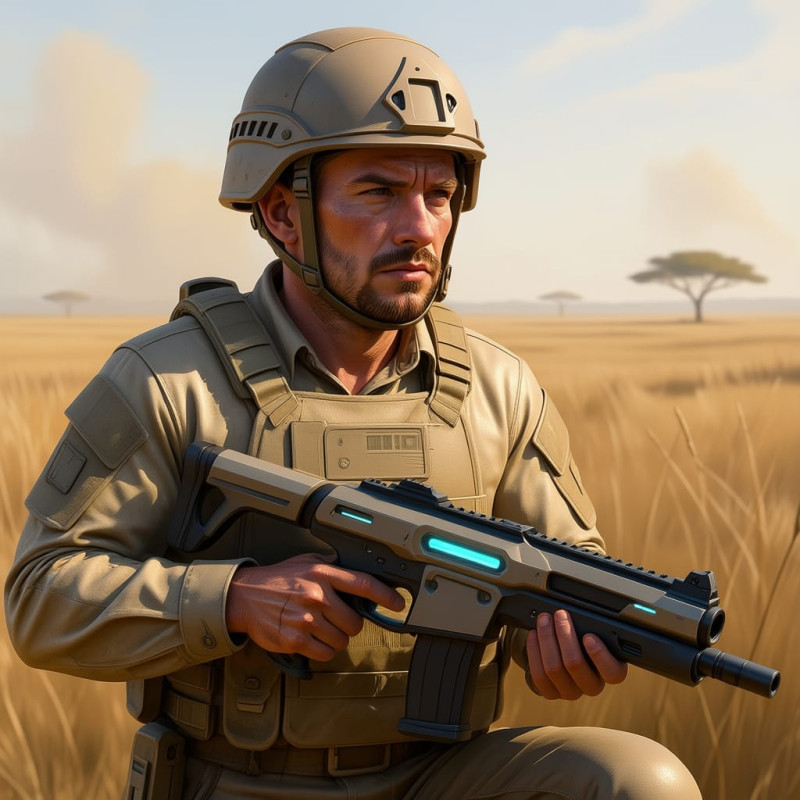
But even that clarity is uneasy. Because at the time, it was just another escalation—another development to be interpreted, contained, explained. The technologies involved only deepened the uncertainty. Infantry units carried systems that had barely left testing. BEMP rifles, designed not to tear through armor but to interrupt the human body itself, left no visible mark. Mass‑drivers struck with force that could be heard long before it was understood. To later observers, the scene feels decisive: two advanced coalitions testing new forms of warfare in open terrain.
To those within it, it was something else entirely—loud, disorienting, and incomplete. Not a clear beginning, but another moment that refused to explain itself.
Others insisted the true beginning came later, with the detonations of the first nuclear weapons in Africa. Early reports, confused by the scale and unfamiliar signatures of the blasts, described them as limited battlefield devices—tactical warheads intended to halt an advancing column or shatter a concentrated formation. That interpretation held briefly because it was easier to accept. It suggested restraint, however fragile, and implied that the conflict still existed within some boundary of control.
But as the days passed and more information surfaced, the neat story unraveled. Reports from the ground clashed with official statements; images told a different tale than the one first imagined. Piece by piece, the scaffolding of the assumption gave way until it collapsed entirely, leaving only questions in its place.
Forensic and intelligence assessments confirmed that the detonations were the result of strategic intercontinental ballistic missile warheads, not the smaller, lower‑yield tactical devices initially assumed. The delivery systems originated far beyond the operational theater, indicating a level of logistical preparation and command authorization incompatible with the notions of hasty battlefield decisions. The operational profile—target selection, launch coordination, and warhead yield—pointed to a deliberate strategic choice, one that required the integration of national command authority, missile forces, and targeting intelligence. The implications were immediate: the conflict had crossed a threshold into a domain of warfare that, by its nature, could not be contained or reversed.
The destruction of a British brigade north of Lake Victoria was effected by a single high‑yield detonation whose magnitude far exceeded the parameters of conventional or even tactical nuclear strikes. Remote sensing platforms, including orbital surveillance satellites, were initially unable to process the event in real time due to sensor saturation and algorithmic misclassification. The resulting shockwave expanded in a near‑perfect sphere, generating overpressure sufficient to obliterate terrain features, induce localized atmospheric disturbances, and disrupt electromagnetic transmissions over hundreds of kilometers. The resulting communications blackout was not the product of targeted electronic warfare, but rather the by‑product of an environment rendered temporarily hostile to the operation of unshielded systems.
When the reconnaissance drones finally reached the site, the images they sent back stripped away any lingering illusions about the scale of the strike. The ground was no longer a battlefield but an artifact—an immense, circular scar where the earth’s surface had been burned into a single, featureless texture. Vehicles were gone in every meaningful sense, their remains reduced to warped, fused masses that bore no resemblance to machines. The surrounding land carried the geometry of destruction in perfect rings: grasslands flattened, tree lines shattered, and the horizon itself blurred by a haze of fine particulate matter. This was not simply damage; it was the physical rewriting of the environment, a transformation so complete it would be studied as both a military and ecological event for generations.
From an analytical perspective, this moment constituted a decisive inflection point in the conflict's trajectory, marking the transition from incremental, quantitative escalation to a profound qualitative transformation in its very nature. For decades, a carefully maintained threshold—sustained through the interplay of political deterrence, deeply ingrained psychological taboos, and codified strategic doctrines—had served as a stabilizing force, preventing the most extreme forms of military engagement. That threshold was not merely crossed but shattered in a manner that left no room for misinterpretation.
The deployment of strategic nuclear warheads did not simply mark a turning point—it broke something that many had assumed could not be broken. For decades, there had been a quiet belief, almost a comfort, that distance still mattered—that oceans, borders, and sheer geography could offer some measure of protection. That belief did not erode gradually; it collapsed all at once. In its place came a far harsher realization: there was no “far away” anymore. No safe remove. No meaningful separation between those who fought and those who watched. The very idea that destruction might remain contained within a battlefield gave way to something far more disturbing—that it could be delivered anywhere, at any time, with a scale that ignored all proportion.
And with that collapse came something worse: the quiet abandonment of restraint. Not openly declared, not always acknowledged, but unmistakable in its consequences. The expectation that force would be measured, that it would serve defined objectives, gave way to a readiness—sometimes deliberate, sometimes accepted—to unleash devastation far beyond anything that could be justified as military necessity. Entire cities became theoretical targets. Civilian life became collateral not in passing, but by design. The language of strategy continued, but it began to feel detached from the reality it described, as if words like “deterrence” and “security” were struggling to keep pace with what had already been set in motion.
What followed is often described in clinical terms: a new era of warfare, defined by speed, reach, and technological escalation. But that description feels almost evasive. Because what it really meant was this—limits stopped holding. The battlefield was no longer a place; it was everywhere. Front lines dissolved into abstractions. Decisions that once unfolded over days or weeks compressed into minutes, sometimes seconds, made under the pressure of consequences no one could fully grasp. Diplomacy lagged. Law struggled to remain relevant. Even deterrence, once treated as a stabilizing force, began to feel like a fragile balancing act conducted over an abyss.
And beneath all of it was a growing, uneasy awareness that something essential had been lost. Not just control, but the belief in control. Victory became harder to define. Defense became conditional. Security, once the goal, began to look more like a temporary illusion. Every decision carried with it the possibility—not just of failure, but of irreversible catastrophe. And that possibility did not sit at the margins; it moved to the center of every calculation, shaping choices in ways that were rarely spoken aloud but always understood.
From that point forward, the question was no longer how far the conflict might spread. It was whether anything still existed to stop it. Whether political judgment, moral restraint, or even physical limitation could still impose boundaries on a system that had already demonstrated its willingness to exceed them. And the most troubling part—the part that lingers—was how uncertain the answer had become.
There is a particular strain of commentary that tries—still—to locate the “true” turning point late in the war, as if doing so might contain the damage, might suggest that catastrophe was delayed, not inevitable. It points to 2025, to the moment when Kamala Harris authorized deployments that placed American and Russian forces in direct proximity. The argument is clinical, almost careful: earlier battles mattered, yes, but did not fundamentally alter the balance. This, they say, was different. This was an escalation made irreversible.
But even that framing feels like a kind of evasion. Because by the time that order was signed, the war had already shown exactly what it was capable of becoming. The idea that reconciliation remained possible up to that point—that there was still a clean threshold separating restraint from disaster—reads less like analysis and more like wishful thinking. The risks of direct engagement between nuclear powers were not new. They had been understood from the beginning. What changed was not the nature of the danger, but the willingness to step fully into it.
By then, the conflict had already spread, uneven but relentless, across regions that had once seemed disconnected. There were still questions, of course—whether it might stall, whether exhaustion might force negotiation—but those questions grew thinner by the day. Diplomats rushed to assemble agreements no one fully believed in. Intelligence reports grew darker, not clearer. Civilian casualties mounted in ways that no longer shocked, only accumulated. Markets trembled, adjusted, trembled again. Institutions met, issued statements, and failed to alter the trajectory in any meaningful way.
And then came the authorization—brief, procedural, almost forgettable in its wording. That, perhaps, is what makes it so difficult to accept. Not that it was dramatic, but that it wasn’t. Another document. Another justification. Another invocation of stability, deterrence, necessity. But this was not containment. It was commitment. Not an effort to hold the line, but a decision to step beyond it.
The consequences did not wait. They never do. Movements accelerated. Airspace tightened. Calculations shifted overnight. What had been hypothetical became immediate. And beneath the surface—behind the briefings and the statements—there was something else, harder to quantify: the quiet recognition that a line, once crossed, does not reappear simply because one regrets stepping over it.
What followed only deepened the sense that something had gone irreversibly wrong. The conflict did not resolve into clarity; it expanded into complexity. It stretched northward, into the Arctic and the Pacific approaches, into environments as unforgiving as the decisions that sent people there. Soldiers operated not under banners or speeches, but under ice, wind, and silence. The distances were deceptive. The margins for error vanished. Every movement carried a consequence measured in seconds.
And still, the machinery advanced. Positions were reinforced. Patrols continued. Systems were deployed that spoke less of defense than of preparation for something worse. Even the language shifted—toward capability, toward reach, toward what could be done rather than what should be avoided. Mass drivers, surveillance grids, forward outposts carved into permafrost—it all carried the same implication: this was no longer about ending the war. It was about sustaining it.
That is the part that resists justification. Not any single decision, not any one moment, but the accumulation—the steady acceptance of escalation as process rather than failure. Each step is explained. Each action is defended. And yet, taken together, they point somewhere far less defensible: to a system that, once set in motion, continues not because it must, but because no one succeeds in stopping it.
And that is where the editorial voice cannot remain neutral. Because whatever arguments are made about necessity, about deterrence, about balance, they all circle the same absence. The absence of a point at which someone, somewhere, refuses to proceed in the absence of a limit that holds.
War does not become catastrophic in a single instant. It becomes catastrophic through permission—granted increment by increment, decision by decision, until what once seemed unthinkable becomes routine. By the time it is recognized for what it is, it is already too late to call it anything else.
They spoke of them in technical terms, as if precision could make them less frightening. Mass drivers. Rods. Density. Velocity. But the reality was harder to escape. At speeds approaching lightning, tungsten and steel were hurled across distances with a force that not only penetrated armor—it erased it. The Russians favored dense tungsten, built for impact. The Americans used stainless steel, tuned for speed and stealth. It was all described as optimization, calibration, and engineering. But beneath that language was something far more unsettling: weapons designed to strike without warning, without sound, without even the dignity of recognition.
Worse still was how little anyone actually knew. These systems were hidden—buried beneath ice, disguised as storage, spoken of only in fragments. Analysts speculated about their range, their yield, their limitations, but certainty never came. And that uncertainty became its own kind of weapon. Patrols avoided certain areas not because they understood the danger, but because they feared what might be there. Ships adjusted course. Commanders hesitated. Entire movements were shaped not by confirmed threats, but by the possibility of something invisible and unstoppable waiting just out of sight.
That is what made the Arctic different. It was not just cold, not just remote—it was haunted by things no one could fully see or measure. Every movement carried risk. Every decision carried the unspoken thought: what if something is already in motion?
And yet, there was no single moment when it all broke open. Instead, there was a tightening. Interceptions grew sharper. Surveillance was more intrusive. Electronic interference became constant, no longer a background condition but a presence that blurred the line between watching and fighting. Incidents multiplied—small, containable, explainable. Each one dismissed. Each one added. Until the pattern began to form, and even then, no one could quite say what it meant.
Historians still argue over what to call it. Some insist it was not war—not yet. They point to the orders signed by Kamala Harris and framed carefully in the language of stabilization, deterrence, and protection. The words are familiar. Reassuring, even. The idea that this was meant to prevent war, not begin it. Those rules of engagement were restrictive. That posture remained defensive.
But those arguments feel thin when contrasted with the unfolding reality. Because the Arctic did not behave like earlier theaters. Distance no longer bought time. Technology erased hesitation. Patrol routes overlapped. Signals were misread. Encounters that should have been routine carried the weight of something much larger. And in that environment, intent became almost irrelevant. A defensive move could look like provocation. Observation could feel like an intrusion. Presence alone could trigger a response.
Diplomacy continued, of course. It always does. But it lagged—always just behind events, always reacting to something that had already happened. Reassurances arrived too late. Clarifications came after tensions had already hardened. Meanwhile, each interception, each shadowed vessel, each flicker on a radar screen added pressure to a system that was already straining.
And this is where the fear settles in. Not in any single weapon, no matter how destructive, but in the way everything connects. The hidden systems beneath the ice. The compressed timelines. The misread signals. The language that insists on restraint while reality moves steadily away from it.
Because in that kind of environment, it does not decide to start something irreversible. It takes a mistake. Or worse—a perfectly rational action, seen from the wrong angle, at the wrong moment. And by the time anyone realizes what it has become, there is no space left to stop it.
In that narrowing space between intention and interpretation, the entire premise began to come apart. What was described as prevention started to look indistinguishable from participation. Actions taken in the name of stability carried the same shape—and often the same effect—as escalation itself. The distinction between presence and pressure did not collapse all at once; it eroded quietly until it could no longer be trusted. And as operations accelerated, so did the danger. Not of some grand, deliberate decision—but of something smaller, almost incidental. A misjudgment. A misread signal. The kind of moment that, in another context, would have passed unnoticed, but here carried consequences far beyond itself.
This is the part that should give pause. Because even the more charitable interpretations—that the strategy was sound but overtaken by events—begin to feel inadequate. The problem was not simply execution. It was the assumption that such a situation could be controlled at all.
Other observers dispense with that assumption entirely. They argue, more bluntly, that the distinction between “limited action” and war was never real in the first place—not under these conditions, not with these capabilities, not with two nuclear powers operating in direct proximity. There was no safe distance, no uncontested space, no buffer left to absorb mistakes. Aircraft shadowed one another in tight corridors. Naval forces tracked each other beneath shifting ice. Electronic interference was not occasional—it was constant. Under those circumstances, “restraint” was not a policy. It was a gamble.
And a fragile one. Because restraint is not something that can be declared and then relied upon, it has to be chosen, again and again, under pressure, in moments where clarity is in short supply. Pilots flew knowing that a minor deviation—a few feet of altitude, a slight shift in heading—could be interpreted as intent. Commanders issued rules designed to prevent escalation, but those rules could not anticipate the exact moment when everything hinged on a single, split‑second decision. The environment itself worked against them: shifting ice, extreme weather, long stretches of darkness. Uncertainty was not the exception. It was the baseline.
Even the systems meant to provide clarity proved unreliable. Communications failed. Signals dropped. Radar returns are blurred. And in a setting like that, ambiguity is not neutral—it is dangerous. A delayed response, a lost contact, an unclear reading could trigger reactions that, elsewhere, would have seemed excessive. But here, excess became understandable. Expected, even. Each side knew the other could act quickly and decisively. That knowledge did not produce calm. It produced suspicion.
And over time, something even more troubling took hold: risk began to feel normal. Close encounters that once would have shocked became routine. Aggressive maneuvers stopped standing out. Electronic interference faded into the background. What had once been escalation became the baseline, and once that happens, it becomes harder to recognize when things have gone too far—because “too far” keeps moving.
In the end, the system did not hold because it was well-designed. It held—barely—because individuals chose repeatedly not to push it further. A pilot who held course instead of reacting. An officer who waited rather than advance. A technician who chose not to escalate a signal exchange. These were not grand acts of strategy. They were small decisions, made in isolation, holding together something that had no real structural stability.
And that is the most unsettling truth of it. Clear limits or reliable safeguards secure the absence of open conflict. They depend on restraints that could never be guaranteed, sustained by people placed in conditions where error was inevitable. War, in this form, did not wait for intention. It waited for a moment—any moment—when restraint failed.
In retrospect, the term “police action” feels less like a description and more like an evasion. It softened what could not be softened. It gave governments a way to speak without admitting what they were doing, to act without naming the consequences. But words do not change reality. Two advanced militaries moved into sustained, contested proximity, and no amount of careful phrasing could disguise what that meant. The Arctic did not simply host the conflict—it stripped it bare, exposing how fragile those distinctions had always been.
What matters is not how the deployment was described, but what it set in motion. Earlier phases of the war still allowed distance—room to maneuver, to disengage, to pretend that escalation could be paused. In Africa and elsewhere, forces could pull back without immediately forcing a confrontation between major powers. The Arctic erased that possibility. Presence itself became confrontation. Every movement was seen. Every signal was challenged. Every mistake mattered.
Small, seemingly trivial incidents began to accumulate, each one like a grain of sand finding a place in a growing heap until the subtle pattern was hard to overlook, and the cumulative weight of everyday slips pressed against the nerves of everyone watching.
A flight path was steered off its intended course by a sequence of small, technical nudges and ambiguous directives, not a single dramatic violation, but a gradual drift caused by conflicting signals, tired routines, and intermittent miscommunications that added up over time.
A radar lock lingered for just a moment longer than necessary, long enough to be noticed and to invite interpretation, suggesting not calm routine but hesitancy, overcautiousness, or a creeping sense of power that could be read as a threat in hindsight.
A communications blackout was read as evidence of intention rather than mere error, turning silence into a potential message and amplifying suspicion as observers wondered what motive lay behind the absence of a normal response.
None of these, on their own, amounted to war; individually, they could plausibly be dismissed as missteps, glitches, or bad luck, explanations that kept restraint and diplomacy viable if considered in the right light.
Together, they formed a tightening chain—one that no one could quite break, and no one could fully control—an escalating sequence in which each link tightened the next, narrowing options and leaving leaders feeling boxed in by a momentum that they could neither reverse nor govern.
That is why even the question of when it began resists a single, definitive answer, because the roots stretch across overlapping moments and slow, cumulative shifts rather than a lone, neatly labeled starting line. Some observers point to a moment that seems, looking back now, unmistakable and decisive: the very first major armored clash on the Serengeti, a confrontation that feels like a hinge turning in history and a milestone that future historians might cite as the obvious starting point of this era. There, under a sky already crowded with machines—the whine of rotor blades, the distant thump of engines, and the glimmer of metallic hulls—the German and Russian expeditionary forces met in open battle, deploying armor and infantry across the plain as if testing rival strategic theories in live turf. Later imagery would render it with unnerving precision, distilling the chaos into a set of visible markers: columns moving steadily through dust and tall grass, drones circling overhead like watchful eyes, and contrails cutting across the upper atmosphere where faster, lighter weapons hunted one another beyond sight, leaving trails memory could replay in slow motion. Seen from here, it looks, almost inevitably, like a beginning—a starting point that invites retrospective framing, a moment that some readers and analysts treat as the opening line in a longer narrative about mechanized conflict and the reshaping of global power dynamics.
Orders became more precise, but execution depended on human reflexes pushed to their limits. A single misread signal could cascade into something irreversible. Deterrence, once buffered by time and diplomacy, now operates in real time. There was no pause left in the system—only reaction.
Commanders made decisions alone. Analysts stopped asking “if” and began asking “when.” The language shifted, almost without notice, from caution to inevitability. And still, officially, there was no war. Not yet. But the distance between “not yet” and “already” had nearly vanished.
The debate persists because it has no clean answer. Was the Arctic already a war in everything but name? Or was it something that became war simply because it could not remain anything else? The distinction feels thinner the longer one looks at it. Intent mattered less than consequence. Labels mattered less than outcomes.
Without a fixed front, even the idea of war began to blur. Preparation and combat overlapped. A convoy could become a target before it moved. A reconnaissance flight could become an engagement before it ended. The old boundaries—temporal, geographic, conceptual—no longer hold.
And so the center of gravity shifted northward, to a place that resisted every traditional idea of a battlefield. The Arctic offered no depth, no separation, no safe distance. Ice, water, and sky formed a continuous space where everything was seen, and little was hidden. There was no “front line” because there was no space left to create one.
Contact became constant. Even in silence, forces existed within each other’s awareness. Surveillance overlapped. Signals collided. Decisions were made instantly, often without certainty. The slow escalation that once defined conflict—testing limits, recalibrating—no longer applies. Everything moved at once.
Inevitability did not arrive as a revelation. It emerged as a condition. When systems operate in such proximity, escalation no longer requires intent—only accumulation: mounting pressure, repeated misinterpretation, and time compressed beyond the limits of human judgment.
Distance, once a safeguard, became meaningless. The Arctic looked empty on a map, but in reality, it was saturated with submarines, satellites, sensors, and overlapping detection systems. Nothing of consequence went unseen for long. And nothing seen could be ignored.
That was the shift. Not where the war began, or even where it first escalated—but where it could no longer be managed. Where restraint became the only barrier left, and even that barrier grew thinner with every passing hour.
Because nothing there was truly passive. Aircraft did not patrol—they shadowed. Ships did not transit—they tracked and were tracked. Beneath the ice, submarines moved in silence that was never complete. Above, surveillance systems reduced uncertainty while stripping away time, forcing decisions faster than thought.
Restraint became an action, not a state. It had to be chosen again and again, in every encounter. A minor deviation—a signal, a maneuver, a misread—could carry consequences far beyond its scale. The margin for error remained, but it narrowed until it barely existed.
Worse still, the systems designed to maintain control began to undermine it. Automated defenses, predictive targeting, rapid-response protocols—all built to act faster than humans—introduced a terrifying possibility: that escalation might no longer be a choice at all, but a reaction. A chain of responses moving too quickly to stop.
And so everything held, but only just. Not loosely, but under tension. Sustained by discipline, by training, by fear. There was no clear threshold left to cross—only pressure building, moment by moment, encounter by encounter.
Until, eventually, it didn’t hold.
The Arctic did not wait for war to arrive. It contained it already—latent, structured, ready. All it required was a fracture. Something small. Something human.
And for the public, none of this began with strategy or doctrine. It began with something quieter. An image. A fragment. A moment replayed until it became impossible to ignore.
People saw it, at first, as just another report. Then something about it lingered—the framing, the silence, the details that did not quite make sense. It appeared again. And again. Each time, clearer.
Eventually, it stopped being something people had seen. It became something they recognized.
That was when the war changed.
Not because of its scale—but because, for the first time, it became real. And what made it unbearable was not how much it showed, but how little it needed to.259Please respect copyright.PENANAbtwFRaGJHH
It did not reveal the full scope of the conflict, nor did it explain how it began or where it would lead. But it did something more unsettling: it made the change undeniable. It showed, without commentary or analysis, that something fundamental had shifted. Distance—the quiet buffer that once softened the weight of distant events—fell away. In its place came a kind of closeness that had nothing to do with geography and everything to do with feeling.
After that, nothing arrived the same way again.
Reports of troop movements, of clashes, of escalation no longer stood on their own. People measured them—consciously or not—against that first image, that first moment of recognition. Each update carried an echo of it. Each headline felt less like information and more like confirmation. Even as the war spread across continents and into domains most had never imagined, attention kept drifting back to that beginning—to the instant when it stopped being something observed and became something experienced.
Historians would later argue over dates and decisions, assembling timelines that tried to impose order on what had unfolded. They would debate causality, assign weight to one moment over another, and search for clarity in retrospect.
But for those who lived through it, the beginning resisted that precision.
It was simpler than that. And far more difficult to accept.
It was the moment they saw it—and felt, with a certainty they could not explain, that the distance was gone, and that whatever had begun would follow them home.
259Please respect copyright.PENANAGM6rUBhak1
259Please respect copyright.PENANAIZOZh0v2ca
259Please respect copyright.PENANASiKLDjiU0q
They called it World War Demi Lovato at first—an almost absurd name, the kind people use before they understand what they’re naming. Then it became World War DL. Then just WWDL, as if shortening it could make it smaller, more manageable, less shameful. It never did. It lingered in memory the way 1914 does—not simply because of how much it destroyed, though it would scar continents—but because of how it began: not with clarity, not with decision, but with a structure no one bothered to see.
This was never a clean war. It did not rise from a single border, a doctrine, or a line drawn on a map. It seeped out of everything people had built and then stopped questioning—alliances left informal because they were convenient, dependencies left unspoken because they were profitable, influence that moved faster than diplomacy and was treated as harmless because it felt intangible. By the time anyone tried to trace cause and effect, the lines had already tangled beyond recognition.
Historians later tried to sound composed about it. They used phrases like "systemic interdependence" and "nonlinear escalation," as if careful language could redeem the carelessness that came before. But strip that away, and what remains is simpler, and far more bitter: the world was tightly bound together, and no one wanted to admit how fragile that made it. Power no longer sat cleanly in governments; it bled into corporations, media systems, personalities—into places that answered to no single authority and carried no single responsibility. Everyone influenced the outcome. No one owned it.
And beneath it all, something else festered—something people preferred not to see. Governments still made speeches, signed papers, and moved forces. But the real pressure came from elsewhere: from attention, from narrative, from the quiet but relentless pull of public perception. Events didn’t unfold in sequence anymore; they collided. They overlapped. They amplified each other until no one could say where anything truly started.
That is why the comparisons to 1914 never quite sit right, and yet refuse to go away. Back then, dynasties bound nations together so tightly that a distant crisis became personal to a handful of rulers. This time, networks did something worse: they made distant crises immediate to everyone, all at once. Not through obligation—but through visibility. Through emotion. Through a thousand points of connection, no one could switch off.
And somehow—absurdly, tragically—it all converged on one person.
Not in the way people thought at the time. Not as a cause. Not as a decision-maker. But as a point where too many lines crossed at once.
That is the part that still unsettles people—the question that refuses to settle into history.
Did anyone see it coming?
Researchers have spent years digging through what remains: declassified files, fractured communications, half-preserved archives. They’ve proven the system existed. That much is undeniable. But proof of awareness? Of recognition? That remains just out of reach, like something glimpsed but never held.
There are hints. Always hints. A briefing memorandum was mentioned later in passing. A memo warning about “convergence risk” tied to high-visibility humanitarian figures; a meeting scheduled—and then quietly erased. None of it adds up. All of it feels like it almost could have.
Was she warned? No one can say.
And the silence spreads outward from there.
Inside The Walt Disney Company, the records that might answer the question remain sealed, lost, or never kept. If analysts noticed the strange feedback loops—the way attention, geopolitics, and real-world events began to echo each other—those observations never surfaced in time to matter. Or never surfaced at all.
Among organizations like WE Charity, Save the Children, and Global Citizen, the silence is just as complete. These were groups built to notice instability, to read early warning signs in places others overlooked. And yet, if anyone there understood that her presence was not just humanitarian—but structural, systemic—no record of it remains.
If warnings existed, they dissolved into the noise.
And that may be the most damning part of all.
This was not a failure of missing information. It was a failure of connection. Intelligence agencies saw patterns. Corporations saw engagement. NGOs saw conditions on the ground. Each saw something real. Each saw something incomplete. No one saw enough.
The system did not hide its instability. It whispered it—over and over—in fragments too small to alarm anyone on their own.
And so the possibility lingers, impossible to prove, impossible to dismiss: that the warnings were there all along, scattered across institutions, visible only in hindsight, meaningless in isolation.
As for Demi Lovato—whether she ever sensed any of it may be a question history cannot answer. People who knew her spoke of awareness, yes—but human awareness. Situational. Immediate. The kind that helps someone step into danger, not step back from a system no one has explained to them.
If she was warned, it likely sounded like everything else: another caution, another concern, another moment in a life already lived at the edge of too many worlds.
And so historians are left with something that feels less like a conclusion and more like an indictment.
If anyone knew, they did not know enough.
If they suspected, they could not prove it.
If they warned, no one understood.
And if no one knew—if this entire structure moved forward without recognition, building quietly toward the moment it would break—then the truth is harder to live with than any single mistake.
Because it means one of the most catastrophic failures of the modern world did not happen in darkness.
It happened in plain sight.
Everywhere.259Please respect copyright.PENANARxCFGXpjvb
And nowhere.
Right up until the moment it was too late to look away.
259Please respect copyright.PENANAUfXvUS4sP1
259Please respect copyright.PENANAtRaV3JAfyO
People like to dress it up now—tidy comparisons, careful phrasing—but don’t let that fool you. The parallel to 1914 isn’t something historians discovered; it’s something the world walked straight into. The same pressures were there: rivalry sharpened into habit, alliances tangled into obligations no one could cleanly escape, and technologies accelerating faster than anyone could control. At the time, people told themselves the system would hold. They always do. Institutions would absorb the shock. They always think that. Looking back, it’s almost unbearable how obvious the cracks were—distrust layered on distrust, arms racing ahead of restraint, and no mechanism strong enough to stop any of it once it started moving.
If the German Empire once tested the limits of its world, then Russia did the same here—not as a mirror image, not as some lazy historical repeat, but with the same dangerous confidence. It acted as though the system around it could be read, predicted, and managed as if consequences would arrive in measured, negotiable steps.
They never do.
And the worst part—the part that still grates—is that neither system understood the thing it was actually acting inside.
In 1914, the assassination of Archduke Franz Ferdinand set off a chain reaction because it struck a web that everyone at least recognized: alliances, timetables, obligations. People knew the structure, even if they underestimated it.
In 2018, the killing of Demi Lovato did something just as explosive—only this time, the network wasn’t written down anywhere.
No treaties.259Please respect copyright.PENANATEfz9VaWJC
No formal chains of command.
Just attention.
Relentless, global, instantaneous attention—systems built to carry an image, a reaction, a wave of outrage across the planet before a single diplomat could clear their throat. And at the center of it—without choosing it, without controlling it—stood one person.
That’s where the comparison stops being clever and starts being disturbing.
Because in 1914, the victim belonged to the power. A royal figure. A node everyone understood.
Here? A civilian. No command. No authority. No army. And still—her presence shifted conditions, and her absence detonated them. Not metaphorically. Systemically.
Historians still trip over themselves trying to name what followed. They call it escalation, miscalculation—anything that sounds like it might still be contained in theory.
Others drop the pretense.
They call it what it looked like: the largest stalking event in modern history.
Because that’s what the record shows when you stop sanitizing it. A pattern of attention that hardened into intent. Surveillance that stopped being abstract. Tracking that stopped being routine. A state didn’t just monitor a region or a threat—it fixed its focus on a person.
And then it acted.
Everything after that unfolded exactly as the system had been trained to respond. Media didn’t pause—it amplified. Governments didn’t hesitate—they interpreted through fear, exposure, and precedent. Institutions reacted not just to the killing, but to what it meant: that visibility itself had become a vulnerability no one could defend against.
Each reaction made sense on its own.259Please respect copyright.PENANAr4RZXaivWM
Together, they became something no one controlled.
Just like 1914, the machinery kicked in fast.
But this time it didn’t wait for declarations, for mobilization schedules, for official language to catch up. It ran on something quicker, messier, more volatile: shock transmitted at a global scale. Grief. Rage. The kind of emotional velocity diplomacy has never known how to slow down.
And that’s how two systems—never meant to intersect—collided.
On one side, the old logic: states, deterrence, escalation. On the other hand, something newer and far less stable: visibility, narrative, emotion moving at the speed of light.
Between them? One event.
And when it snapped, it exposed something people still don’t want to admit.
In a world where influence spreads everywhere, and responsibility sits nowhere… attention itself becomes power. And if one person stands at the center of enough unseen connections, their death can still do what it did a century ago.
Start a war.
Not because anyone planned it.259Please respect copyright.PENANA1rmKms7ka9
Not because it had to happen.
But because the structure—the one nobody bothered to see—had already made it possible.
So no, the comparison to 1914 isn’t rhetorical. It’s not a metaphor historians reach for when they run out of better ideas.
It’s structural.
And like Sarajevo, the real horror isn’t just the act.
It’s the realization that the world had already arranged itself in such a way that the act could matter that much—and no one stopped it.
259Please respect copyright.PENANAx22F4hVEuM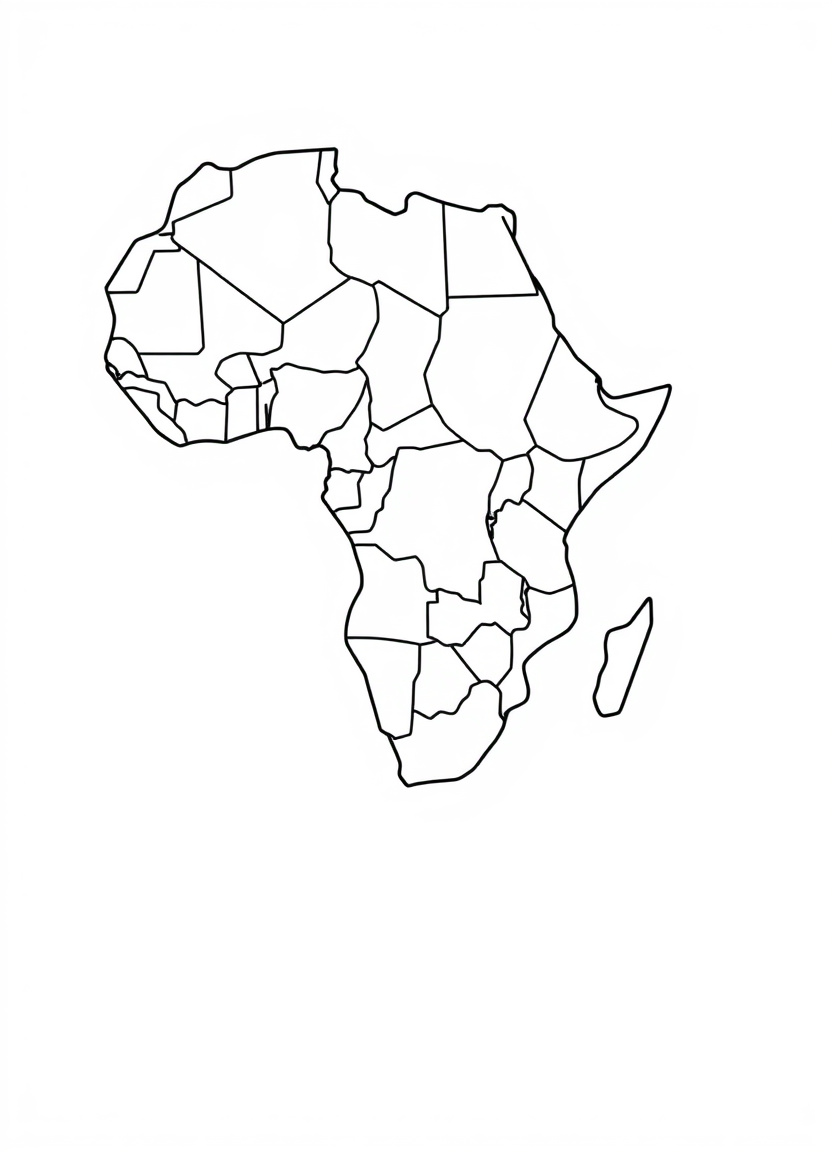


 and then Add to home screen.