

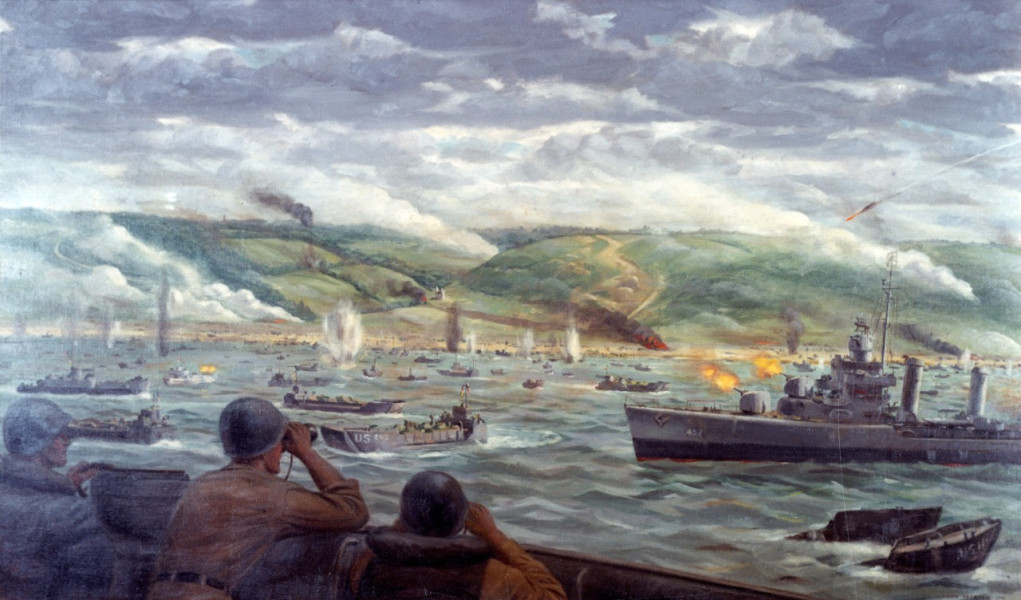
DD-724 Laffey, also known as the “Ship That Wouldn’t Die”, rests quietly at Patriots Point with only her memories to guide her—especially her debut mission at the turn of World War II, D-Day.
Laffey remembers the sailors, the conflict, and how Gun Mount 52 took out two German pillboxes. She also remembers the special occasion on June 6th, 2024: Patriots Point celebrated the 80th Anniversary of her and her crew’s actions at D-Day and beyond.
“It was my first battle. We had every right to be nervous, but Captain Becton’s training ensured we succeeded. Now there we were on June 6th, celebrating this great battle.”
First commissioned at the Boston Navy Yard in 1944, Laffey was named in honor of DD-459, the first Laffey, which was sunk violently at the Battle of Guadalcanal in 1942. 14-inch guns and a torpedo caused a massive explosion that broke DD-459 in half. It was now time for DD-724 to avenge her.
Laffey’s first task was to escort a convoy, a group of ships and vehicles, to England in March and April. Operation Neptune, the naval phase of D-Day, added the ship to the fleet, where she and the sailors mentally prepared for war.
“Like any young soldier, we were excited and nervous about the future. Becton suffered a great loss before he became captain and never recovered, so he decided to be the best captain he could.”
D-Day was initially scheduled to begin on June 5th, so on June 3rd, Laffey and the convoy lined up and set sail for Normandy.
“The weather was turbulent: high waves and sheets of rain that damaged ships in the convoy.”
Because of the weather conditions, General Dwight Eisenhower, commander of Operation Overlord (codename for D-Day), postponed the invasion for twenty-four hours; however, the postponement’s announcement didn’t reach Laffey until 9:00 AM on June 4th.
“Everything was ready, and then they ordered us to return to Plymouth. It was a kick in the face on one hand, but also a breath of relief on the other. I don’t know if sailors can perform their best if they are seasick in inclement weather, I thought, so I guess it’s a win-win situation.”
And win-win it was. By the dawn of June 6th, 1944, the convoy was back on track.
“Operation Neptune tasked us with protecting shore transports from German patrol boats. We silenced twenty-eight German batteries containing 110 guns working as a team.”
At the end of the day on June 6th, 66,000 troops had landed on Utah Beach, thanks to Laffey and the convoy’s tiring efforts. Laffey had suffered no casualties and destroyed two German pillboxes.
“Excellent shooting,” said the shore fire control party on June 9th. “Targets were 88 MM guns… You made a direct hit on two enemy pillboxes… Will call again when we have another opportunity.”
“Our first mission was a success, but we lost one of the original five Destroyers, the Meredith, which disappointed us. We got lucky that time, but what about next?”
With Meredith’s loss, Laffey and her crew realized how quickly a life could end. They bundled up for Phase Two of the battle after refueling and restocking back in England.
Phase Two was when things became interesting. Laffey’s next mission was to apply shore bombardment on German batteries in the Cherbourg Port to help the Allied VII Corps. The result was an intense ship-to-shore battle and a near miss with a German volley.
“In the heat of the battle, we didn’t realize how close that volley came until we withdrew to England for a damage inspection.”
While inspecting Laffey’s degaussing cable, used to “reduce a ship’s magnetic field”, Lead Electricians Mate Al Csiszar found a shell in the boatswain locker that had punched a four-foot hole in Laffey’s port bow.
“How they got that bomb out of the boatswain locker is a story I enjoy sharing.”
Chief Boatswain Mate Al Lewis and a damage control party lifted the 400 lb. shell through a hatch to the top deck.
“The shell was live, so the damage control party had to be careful not to trip it. They worked quickly, carefully, and efficiently. Watching them roll it off the side into the harbor was relieving. ‘Well done, men!’ broke across the deck. That was when I knew we were safe—for now.”
Relieved from the amateurish, inoperable shell, the up-and-coming new ship and crew prepared for their next mission on June 29th. Laffey, two more battleships (BBs), two armored Cruisers (CAs), and ships from DesRon 10 and DesDiv 119 sailed for Belfast, Ireland. Due to an engineering casualty, Laffey had to pull off for an emergency repair.
“I was still a new ship after the repair, so there were kinks we had to work through. Once they finished repairing the casualty, we proceeded independently to Belfast and arrived there on July 1st. It was significant because it proved we could care for ourselves, which was crucial for what awaited us in Okinawa.”
Laffey remained in the European Theater until late July, when the higher-ups concluded she was ready for her next step: the Pacific Task Force. She returned to Boston, and the crew received a month’s leave while her bridge and superstructure were modified.
“That told us that D-Day was only the beginning, but that didn’t mean we weren’t part of the great victory.”
The invasion from D-Day liberated Paris and placed Allied Forces back in Europe, allowing them to begin overthrowing Nazi Germany. Hitler had planned to build his Eastern Front, but D-Day foiled those plans.
“There was light on the horizon, but still plenty of darkness. There wasn’t a single moment when Becton didn’t train the men. He had faith in them, as did I. D-Day proved they were willing to sacrifice to protect their country and end the war. I would not be at Patriots Point today if not for these men. That’s why Destroyer Day was crucial.”
Filled with volunteers, visitors, eight Living History enactors, and members of Alliance Française de Charleston, June 6th, 2024, was busy for Laffey. Alliance Française de Charleston shared information and history about Charleston’s sister cities: Spoleto, Panama City, Speightstown, Freetown, Doha, and Flers. The most notable sister city is Flers (“flowers” in English), Normandy.
“As with any war, civilians and soldiers suffered.”
Just before D-Day began, Flers endured a bombing and was devastatingly destroyed: houses were gone, and streets were in shambles. What was once an exotic seaside town was now a living Hell that crushed the morale of the Flériens.
Word of the bombing reached Charleston, South Carolina, and they decided to take action. Gertrude Sandford Legendre, one of the wealthy owners of Medway Plantation in Goose Creek, asked to speak with the mayor, E. Edward Wehman Jr. She explained that she wanted to help Flers, so she and Wehman began strategizing.
To Flers’s surprise, 20,000 tons of care packages arrived from Charleston, helping them begin rebuilding. They kept up the surprises, sending additional stocks of food and water.
Flers was so grateful that they became Charleston’s sister city. With their morale reborn, they sent them a bouquet to put on display by the Alliance Française de Charleston during Destroyer Day.
“That goes to show how much of an impact people have on one another, especially during times of war. I am grateful that Charleston created the Charleston-Spoleto, Italy Sister City Partnership. Seeing it come to life on Destroyer Day was rewarding.”
The relationship between Laffey, Charleston, and Flers wouldn’t have been possible without the Alliance Française de Charleston. First established in Paris in 1883, it promotes French culture, such as language, art, music, and cuisine. Members don’t have to be fluent in French and understand the culture to join; they merely need to show interest and willingness to learn.
Special guests from the Alliance Française came to Laffey during Destroyer Day: French Vice Council Luc A Chasleries, Treasurer and Patriots Point volunteer Bernard Magdelain, and the founder of Alliance Française de Charleston, Marie-Laure Aranud.
“The day was lively with the enactors, visitors, and alliance. At 2 PM in the theater, the Director of Education, Keith Grybowski, discussed the D-Day Invasion. Afterward, the Volunteer of the Year, Bill Cassasa, reminded everyone of a destroyer’s role in naval warfare. That was when I remembered everything and began opening up. While it’s difficult to discuss war, those who do are the bravest individuals I’ve seen. Every veteran is a hero. They all deserve the Medal of Honor—combat or not.”
While Laffey and D-Day continue to make history, Patriots Point visitors and volunteers embark on their own D-Day, meaning it’s the beginning of their journey, one they will cherish and learn as Normandy’s heroes thrive and teach.
What does D-Day stand for? It stands for Day-Day, which refers to the beginning of an operation, but that is not as iconic as Laffey and her fight for freedom. She is no ordinary destroyer, no Day-Day, only another soldier with her own stories, stories she chose to share on June 6th, 2024.
ns216.73.216.38da2

 and then Add to home screen.